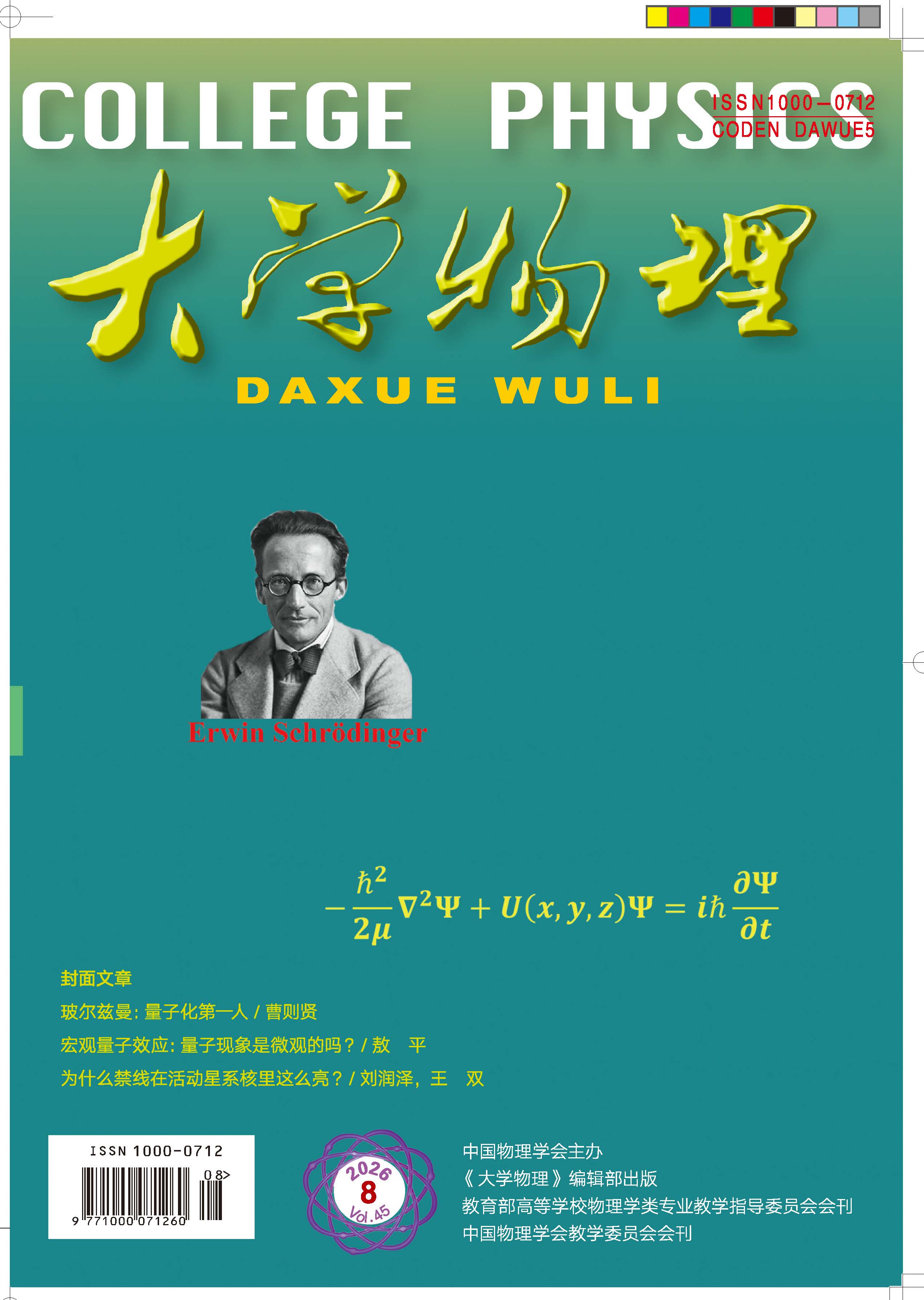
Journal Information
College Physics
Founded in 1982
Supervisor: China Association for Science and Technology (CAST)
Sponsor: China Physical Society
Bimonthly
Tel: 010-58808024
E-mail: cop@bnu.edu.cn
CN 11-1910/O4
ISSN 1000-0712
Current Issue
11 November 2025, Volume 44 Issue 9
  • My University
    LIUJie
    2025, 44(9):  1.  doi:10.16854/j.cnki.1000-0712. 250359
    Abstract ( 119 )   PDF (854KB) ( 99 )  
    Based on historical documents, this paper systematically examines the growth process of theoretical physicist Chen Shi-gang during his studies at Fudan University. The research focuses on his academic life in the Department of Physics from 1954 to 1958, analyzing four dimensions: enrollment background, learning process, cultivation of academic interests, and practical application. The findings reveal that under the strong academic atmosphere and guidance of distinguished professors at Fudan University, Chen gradually developed a unique scientific research methodology characterized by exceptional self-learning ability, open exploration spirit, and proficiency in thought experiments. This study provides a representative case for understanding the talent cultivation model of physicists in early New China. 

    Prof. Chen Shigang and his Office
    Fu Libin
    2025, 44(9):  9.  doi:10.16854/j.cnki.1000-0712.250357
    Abstract ( 69 )   PDF (579KB) ( 62 )  
    This paper briefly reviews the authors interactions with and guidance received from Professor Chen Shigang. Professor Chen has a profound theoretical foundation, and his academic guidance to the author is highly inspiring. For instance, in research on the critical behavior of Bose-Einstein condensates in double wells and large spin tunneling, he put forward key ideas and guided the author to improve the research. Chen Shigang is skilled in applying methods such as linearization and perturbation to study complex physical processes, which has a profound impact on the author. The paper also presents Professor Chens life attitude of being quiet, focused and passionate about science, and expresses wishes for his 90th birthday.

    Being a student of Prof. Chen Shigang was the greatest honor of my life
    LIU Zonghua
    2025, 44(9):  12.  doi:10.16854/j.cnki.1000-0712.250358
    Abstract ( 47 )   PDF (648KB) ( 36 )  
    This article briefly reviews the process of my admission to Prof. Chens group and shares some learning experiences with specific examples, including asking more and obtaining more, the Lyapunov exponent condition, controlling chaos and synchronization of conservative systems, the construction of projection operators, the perturbation representation on Poincaré sections, and Prof. Chens care. These contents reflect, from one aspect, the educational ideology and noble character of the older generation of physicists such as Prof. Chen, and still have reference value for todays young teachers and students.


    Research on academic life path of academician Chen Shigang
    LYU Wen-juan1, YUE Ying2, LIU Jie3, HUANG Shuo3, L...
    2025, 44(9):  15.  doi:10.16854/j.cnki.1000-0712.250362
    Abstract ( 53 )   PDF (1450KB) ( 41 )  
    Based on a comprehensive collection of Chen Shigangs academic papers and monographs spanning over half a century (1960~2013), this article categorizes his publications according to research areas. Combined with the historical background, The paper analyzed in detail the changes of Chen Shigangs scientific research interests in different periods, and demonstrated the main scientific achievements and contributions of his research for more than 50 years. Furthermore, through examining research grant projects he led, scientific journals on whose editorial boards he served, and his academic collaborations and exchanges, this study delineates the holistic landscape of his academic life, and clearly show his personal academic system and style.


    Thanks to Professor Chen Shigang: Notes on Doctoral Studies
    XIE Baisong
    2025, 44(9):  21.  doi:10.16854/j.cnki.1000-0712. 250361
    Abstract ( 47 )   PDF (622KB) ( 32 )  
    This article reviews and describes some of the events that occurred during the authors doctoral studies under Academician Chen Shigang from 1994 to 1997. These impressive experiences in learning, research, and daily life not only allowed the author to grow up healthily at that time, but also have long-term enlightening and guiding significance for future scientific research and education work.

    Mentor Chen Shigang: An Academic Guide from Chaos to StrongField Physics#br#
    LIU Jie
    2025, 44(9):  24.  doi:10.16854/j.cnki.1000-0712. 250360
    Abstract ( 48 )   PDF (585KB) ( 35 )  
    This paper traces the academic interactions between the author and Mr. Chen Shigang since their first meeting in 1993, highlighting Chen Shigangs profound expertise as a theoretical physicist and his distinctive mentoring approach. Through key instances such as the discussion on the “three-dimensional maps” problem during their first meeting, the authors transition into strong field physics research under Chen Shigangs guidance, and later guidance on scholarly writing and research methods, the article underscores Chen Shigangs consistent adherence to first principles and his focus on uncovering the essential of a problem. It also reflects his academic wisdom in balancing “interest-driven” and “demand-driven” research. Chen Shigang not only guided the author toward continual breakthroughs in research but also profoundly shaped the authors academic path and approach to nurturing talent through his educational philosophy of “teaching benefits teachers as well as students” and “educating students according to their aptitude.”


    #br#
    2025, 44(9):  28.  doi:10.16854/j.cnki.1000-0712.240593
    Abstract ( 89 )   PDF (963KB) ( 78 )  


    Progress in the study of quasiexact solvable periodic potentials
    QU Feiyang, SHI Jiaxuan
    2025, 44(9):  32.  doi:10.16854/j.cnki.1000-712.240476
    Abstract ( 76 )   PDF (734KB) ( 57 )  
    Quasi-exactly solvable (QES) systems are a class of quantum mechanical models in which part of the energy spectrum and eigenstates can be solved analytically. This paper reviews the definition and development of the QES problem and its importance in physics, centering on the QES periodic potential. By analyzing the energy band structure of the Kronig-Penney model, the Lamé potential, the PT-symmetric periodic potential, and the Mathieu potential, the key role played by these models in the description of the electron behavior in periodic lattices is revealed. In this paper, the energy band properties of the QES periodic potentials and their analytic solutions are systematically explored by combining the theoretical tools of Lie algebra, polynomial invariant subspaces, and supersymmetric quantum mechanics. The results show that different QES periodic potentials exhibit rich energy band structures, which can be used to modulate the bandgap of crystalline materials. The QES system is of great significance in solving complex quantum systems and provides theoretical guidance and prospective ideas for studying novel materials and Non-Hermitian systems.

    The motion of a finite-length straight conductor in a non-uniform magnetic field#br#
    LU Haipeng
    2025, 44(9):  39.  doi:10.16854/j.cnki.1000-0712.250003
    Abstract ( 43 )   PDF (534KB) ( 23 )  
    Under certain approximate conditions. The combined external force and combined external torque acting on a wire of length L carrying a current I in a non-uniform magnetic field generated by a long straight current were analyzed and solved using the knowledge of mechanics in college physics. The motion trajectory of the wire′s center of mass C and the change in the wire′s rotation angle were obtained through numerical methods. The motion trajectory of the wire within one rotation period was further studied. The reasons were analyzed from the changes in velocity and acceleration parameters.

    Stability analysis of opticalresonators using eigenspectrum f round-trip matrix#br# #br#
    #br#
    LI Han, Wang Xudong, WANG Chunsheng, WANG Ying, ...
    2025, 44(9):  44.  doi:10.16854/j.cnki.1000-0712.240506
    Abstract ( 21 )   PDF (619KB) ( 15 )  
    The optical resonator is a key component in modern optical systems, and the study of its stability has significant theoretical and practical importance.This paper analyzes the stability of optical resonators using the eigenspectrum of the round-trip matrix, revealing the intrinsic relationship between stability and the distribution of eigenvalues and the number of eigenvectors.We establish clear and definitive stability criteria by introducing the g parameter and stability diagram.The stability analysis method is further extended from empty resonators to non-empty resonators, broadening the applicability of these criteria.This analytical approach is mathematically rigorous and provides intuitive insights into the physical nature of resonator stability, offering strong theoretical guidance for optical resonator design and optimization.


    Principle analysis and teaching reflection on the double cone rolling uphill experiment#br#
    WANG Pengying, ZHOU Lina, ZHOU Hangyu, KONG Li...
    2025, 44(9):  49.  doi:10.16854/j.cnki.1000-712.240573
    Abstract ( 23 )   PDF (518KB) ( 11 )  
    The double cone rolling uphill experiment is a common science demonstration experiment. However, its principle analysis often remains at a qualitative or semi-quantitative stage. Building a model based on physical objects and analyzing its principles is a key capability and core literacy of the physics discipline. This article takes the double cone rolling uphill experiment as an example, based on the content of University Physics and Theoretical Mechanics courses. By establishing a coordinate system, solving the equation of the center of mass motion trajectory, and analyzing the conditions for the cone to roll up. Additionally, it further derives the speed of the center of mass during the double cone rolling uphill process, discusses the conditions for rolling without slipping, and the position of the contact point between the cone and the inclined track. By using theoretical knowledge to solve practical problems, students′ key capabilities in physics are improved.

    Embody the methodology in teaching - taking the solution of the eigenvalue problem of the associated Legendre equation as an example#br#
    DU Shuang
    2025, 44(9):  54.  doi:10.16854/j.cnki.1000-0712.250052
    Abstract ( 29 )   PDF (551KB) ( 18 )  
    Taking the solution of the eigenvalue problem of the Legendre equation as an example, this paper shows the simple scientific idea that "the solution to a simple problem is often the basis for solving a complex problem, and complex problems can often be transformed into simple problems to solve". On the basis of the relatively simple eigenvalue problem of the Legendre equation, the solution of the associated Legendre equation eigenvalue problem, the associated Legendre polynomial, is constructed, avoiding knowledge points that may exceed the class. Call for more demonstration of the critical thinking process when attempting to solve problems in future textbook development, which should be beneficial for cultivating students ability to solve problems from the perspective of basic methodology.


    Electromagnetic induction transparency of coupled oscillators#br# #br#
    WANG Cairong, ZHANG Lin
    2025, 44(9):  56.  doi:10.16854/j.cnki.1000-0712.240460
    Abstract ( 22 )   PDF (883KB) ( 17 )  
     This paper broadly explains the phenomenon of Electromagnetically Induced Transparency (EIT) through a simple classical coupled oscillator model. By drawing an analogy between the three-level structure in atomic systems and the coupled oscillator system, it first demonstrates how a classical physics model can simulate the transparency phenomenon caused by quantum interference. Subsequently, through theoretical analysis and numerical simulations, the similarities between coupled oscillators and EIT are explored, leading to the development of a general method for understanding the core mechanism of quantum coherence effects using classical coupled models. Finally, based on this method, the phenomenon of induced transparency in optomechanical systems, namely Optomechanically Induced Transparency (OMIT), is further investigated, showcasing the theoretical significance of classical mechanical models in integrating advancements in frontier physics into university-level physics education and in understanding modern scientific research outcomes.

    Research progress of spin seebeck effect
    ZHENG Xiaoli, CAI Jianwang
    2025, 44(9):  61.  doi:10.16854/j.cnki.1000-0712.240484
    Abstract ( 22 )   PDF (1070KB) ( 16 )  
     Heat currents can interact with spin current, leading to the emergence of a new field, spin caloritronics, where the main focus is on exploring the interactions and evolutions among spin, charge, and heat, with the anticipation of further developing related devices with application values.The spin Seebeck effect (SSE) falls within the scope of spin caloritronics.This paper integrates the spin Seebeck effect with university-level physics knowledge.Starting from the basics of thermoelectric effects, it elaborates on the manifestation, measurement methods, and mechanisms of the spin Seebeck effect in material systems.It demonstrates its significance in the field of spin caloritronics and aids university teachers and students in better understanding this cutting-edge physical phenomenon.

    Study of instructional methods in quantum parameter estimation with QuanEstimation#br#
    LIU Jing1, QIN Jinfeng1, 2
    2025, 44(9):  69.  doi:10.16854/j.cnki.1000-0712.240492
    Abstract ( 22 )   PDF (565KB) ( 5 )  
    This paper presents the study of the instructional methods in quantum parameter estimation based on the open-source software QuanEstimation developed by the author’s group.QuanEstimation is the first versatile computational and scheme design toolbox in the field of quantum parameter estimation.Utilizing this software, most precision-evaluation tools in quantum parameter estimation, including the quantum Cramér-Rao lower bound and Holevo Cramér-Rao lower bound, can be efficiently calculated and demonstrated in the multimedia teaching process.The proposed instructional method overcomes the issue of massive mathematical derivations in the teaching of quantum parameter estimation and the inability to intuitively visualize the calculation results.Hence, this method significantly enhances the visualization of teaching.


    A study on the assessment of learning outcomes of physics preservice teachers#br#
    Ding Geman1, 2, Fan Bing1, Guo Zikai1, Lin Siyan3
    2025, 44(9):  74.  doi:10.16854/j.cnki.1000-0712.240528
    Abstract ( 23 )   PDF (476KB) ( 13 )  
    The assessment of learning outcomes among physics preservice teachers serves as a critical foundation for teacher education and continuous improvement, with the selection of assessment tools being particularly vital.This study focuses on evaluating the learning outcomes of physics preservice teachers by constructing a comprehensive assessment model and developing reliable, valid measurement tools.Survey findings indicate that participants demonstrated notable strengths in professional ethics and practical teaching abilities.Analysis by gender showed that female students generally outperformed male students, while urban students displayed significantly higher levels of educational commitment and collaboration skills than their rural counterparts.Furthermore, differences by academic year revealed a steady improvement in both professional ethics and overall educational competency, with senior students significantly outperforming junior students in these areas.


    Research on quantitative analysis of ideological and political teaching #br# evaluation in university physics courses oriented to the cultivation of top innovative talents#br#
    GUO Qiaoneng, CHEN Qiufang, SONG Pingxin, WANG ...
    2025, 44(9):  80.  doi:10.16854/j.cnki.1000-0712.250019
    Abstract ( 23 )   PDF (685KB) ( 12 )  
    Starting from the cultivation of top-notch innovative talents in basic science at “Double First-Class” universities, and based on Constructivism learning theory, this study integrates the cultivation of scientific aesthetic quality, with a student-centered approach to identify the key factors for evaluating ideological and political education in courses. Using university physics courses for basic science majors as an example, a multi-dimensional evaluation index system for ideological and political education in the course is constructed. The Analytic Hierarchy Processis applied to calculate the weight of each index and the overall hierarchical weight table for quantitative analysis of the ideological and political education evaluation. This study provides reference and practical insights for the design of ideological and political education in courses aimed at cultivating top-tier innovative talents in universities.

    Exploration and empirical research on the ideological and political education of new energy specialty courses#br#
    TANGMin1, HEPing2
    2025, 44(9):  87.  doi:10.16854/j.cnki.1000-0712.250062
    Abstract ( 18 )   PDF (547KB) ( 6 )  
    This work, from the perspective of new energy discipline education, analyzes the importance and necessity of integrating ideological and political education into professional courses. It emphasizes the need to closely align with the core professional content, deeply explore its ideological values and spiritual connotations, and enhance the “ideological flavor” in the classroom. Taking the course “Introduction to Energy Science and Engineering” as an example, it demonstrates how to combine course content to strengthen students' national consciousness, dialectical thinking ability, the spirit of scientists, and awareness of scientific ethics and morals. Through the practice and exploration of this work, it aims to provide valuable insights and examples for the classroom and practical teaching in other science and engineering disciplines, helping to build a comprehensive “Great Ideological and Political Course” system and cultivate high-quality, well-rounded science and engineering talents.


    Department of Physics, Tianjin University, Tianjin 300350, China
    WANG Ziyuan
    2025, 44(9):  93.  doi:10.16854/j.cnki.1000-0712.250051
    Abstract ( 30 )   PDF (769KB) ( 17 )  
    This paper proves Wigner Rotation Theorem with a rigorous yet accessible calculation.It derives the properties of velocity composition in special relativity and discusses the monotonicity of physical quantities and several special cases for intuitive understanding.Based on this theorem, it demonstrates the internal consistency of special relativity and derives the conclusion on Thomas precession in atomic physics and quantum mechanics.Given the limited coverage of Wigner Rotation Theorem in textbooks, this paper supplements undergraduate learning in special relativity and quantum mechanics.


    The orbital equation of celestial body motion andthe orbital velocity
    WANG Yaocheng, MENG Junxia
    2025, 44(9):  103.  doi:10.16854/j.cnki.1000-0712.240542
    Abstract ( 15 )   PDF (540KB) ( 6 )  
    At present, the process of calculating the orbits and orbital velocities of celestial bodies involves many advanced mathematical concepts and physical principles, which are rather difficult for teenagers to understand. To facilitate a deeper understanding of celestial motion, this article uses conic sections and their properties, which are easier to understand, to discuss and calculate the orbital equations and orbital velocities of celestial bodies. A concise formula for orbital velocity is derived. Moreover, compared with non-purely theoretical calculation methods, it not only provides a more precise description of the calculation process but also summarizes the motion situations under all velocity ranges, demonstrating the importance of mathematics in physics. It is hoped that this will inspire teenagers' love for physics. 

    An extended study of holography experiment for phase contrast microscopy
    CHEN Yian, SHEN Chengting, ZHANG Tianhui, PANG ...
    2025, 44(9):  107.  doi:10.16854/j.cnki.1000-0712.250061
    Abstract ( 15 )   PDF (819KB) ( 7 )  
    This article is based on the holography experiment in university physics experiments. The setup has been improved by adding a microscope optical path and introducing a rotating glass slide in the reference optical path for continuous and quantitative phase modulation, thereby achieving the function of phase contrast microscopy. With the improved setup, phase contrast microscopic observation of onion epidermal cells was carried out. Compared with traditional microscopy, cytoplasm, nucleus and other microstructures that are difficult to observe without staining in traditional ways can be observed. The improved setup can clearly show students the application of holography in microscopy, producing positive teaching outcomes.


    The experimental design for the measurement of weak magnetic fields based on Faraday principle
    GUAN Xinzhou, YAN Zishun, ZHANG Xinhe, LUO Yun...
    2025, 44(9):  111. 
    Abstract ( 17 )   PDF (937KB) ( 15 )  
    This article describes the construction of an experimental apparatus based on the Faraday effect and its non-reciprocal principle for omnidirectional detection of weak uniform and non-uniform magnetic fields. The system employs ZF6 heavy flint glass, a magneto-optical medium with intrinsic non-reciprocal properties. By implementing a multi-pass optical configuration to propagate the laser beam through the medium repeatedly, the magnetically induced rotation angle variations are amplified. Photodiodes integrated with transimpedance amplifiers convert these angular variations into quantifiable voltage signal modulations, magnetic field strength is obtained solely through voltage data acquisition utilizing either a voltmeter or an Arduino development board. Experimental results confirm that the device achieves high measurement accuracy, rapid response characteristics, low-cost implementation, and user-friendly operation.